Showing posts with label foxglove. Show all posts

Monday, August 16, 2010

Fasciation is Fascinating (not a typo)


Fasciation is when a plant's stem widens out to be abnormally wide instead of round. Here is a small example. The photo on the right is a normal foxglove after blooming. The one on the left is the fasciated top, - the usual place where fasication is found.

The cause of this phenomena is not understood. Reasons for this freak event include: damage to the apical bud [tip]; viruses; herbicides [which surely doesn’t happen in the wild where I have found the most examples]; bacterial infection; cytokinin that appears to have the ability to stimulate the proliferation of a wide spectrum of cell that is found in the xylem. Cytokinin is thought to proliferate cells in the plant; spontaneous mutations; bacterial infection, mite or insect attack; or chemical or mechanical damage. Some plants may inherit the trait.

Among the examples in my collection are: Echium fastuosum [Pride of Madera], an oak stem [it’s rare to find fasciation in hardwoods like oaks], cockscomb celosia [Celosia argentea var. cristata is one of the few plants that passes the mutation on as a true “fixed” fasciation], and evening primrose [Oenothera spp.].

Let me know if you've found a fasciated plant.


Please post a comment - I want to know what you think.

Visit my web site to learn about my new book on drip irrigation and other gardening books.


NOTE: The comments section at the bottom of the post has disappeared. Click on the "___ Comments" button or the title under the "Blog Archives". Thanks, Robert

Posted by Robert Kourik at 7:43 AM 0 comments Labels: Echium, fasciation
Newer Posts Older Posts

Wednesday, July 7, 2010

My Garden


A view of my little garden. I let the foxglove "walk around". A different pleasure each year. This section was drip irrigated for three years, then 20 years without irrigation. Not a benefit to a publisher of my book Drip Irrigation for Every Landscape All Climates.

Monday, May 24, 2010

Foxy Flowers - Foxgloves


My garden is full of dozens of foxglove that have seed themselves, leading to a wide range of colors-from creamy white to pink, rosy pink, and almost deep red.

Our eyes see delightful beauty in our gardens. People see all the colors of the rainbow; red, orange, yellow, green, blue, indigo, and violet. Bees do not see red and can only distinguish between six colors:, blue-green, blue, violet, ultraviolet, and yellow. They can see a color called "bee's purple," a mixture of yellow and ultraviolet.

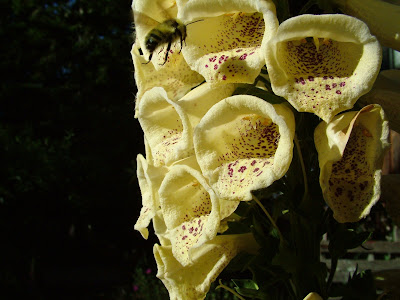
Some of the splendor in garden flower remains unseen. Each foxglove blossom has a different set of splotches all the way into its throat, like little runway guides leading to the sweet nectar. These are intriguing enough. But there’s more. A pollinating bumble bee see something beyond our vision. Bumble bees have a pair of six-sided, compound eyes and three simple eyes. Even with such complex eyes, their sight is accurate for only about three feet. A special light guides bumble bees on their lusty journeys for pure nectar. Bumble bees see ultraviolet light. A pattern of ultraviolet coloration lures a bumble bee into the foxglove flower’s throat. These patterns unseen by our eyes act like the signals of an airport’s landing strip. And the ultraviolet splotches of color don’t match the random splotches we see in the sunshine.

The earth’s protective atmosphere shields us from much of the sun’s ultraviolet light (radiation). Enough ultraviolet radiation filters through to aid bumble bees in their daily journeys. Even on a cloudy day, the bumble bees see the ultraviolet spectrum by cloud-penetrating ultraviolet light. What assists bumble bees on their quest for pollen and nectar can cause us to sunburn—part of the two-sided tapestry of life.

In each blossom the pollen is in the roof of the flower so the upper body of the bumble bee is brushed with the pollen as the bumble bee goes deeper into the blossom to seek out the sweet nectar (as seen here). After flying to another flower, the pollens are mixed and seed formation begins. The pollination process leads to plants with a mixture of colors. An isolated stand with creamy flowers will have cream colors until a seedling of a rose-colored blossom pops up nearby. Then things get interesting as different blends of color appear.


“BUY FROM THE SOURCE TO HELP KEEP WRITERS WRITING”


Let me know what you think. Visit my web site, www. rkourik.com, to learn about my new book on drip irrigation and other gardening books. Thanks, Robert

Wednesday, June 25, 2008

Summer Interlude


We’re slipping into summer. A series of hot spells above 100F has really forced flowers to fade quickly and seed heads to form.

My garden is more like the umber rolling hills of California. That means less growth (especially since I don’t irrigate) and less bloom for color. This is due to the deer that favor most of the plants that blossom in the late summer and fall like: California fuchsia (Zauscneria californica; also classified as Eilobium canum canum); roses (the thorns are not a safeguard); and many other summer-blooming exotics that become breakfast, lunch, and dinner for these beautiful; yet pesky animals.

The exotic grasses that have choked out the native bunch grasses and turn a golden-straw color. Seed heads begin to form to release next years regeneration. It’s only natural that some of my garden reflect this pattern. However, I don’t let the exotic grasses to grow in my garden. And I’m reluctant to dig up the few native grasses that cluster near my mailbox. I might have to; so as to fill in among other plants, but they are not that showy and usually prefer steep slopes where the deer can’t get to them.

However, I allow common foxglove (Digitalis purpurea); euphorbia, (Euphorbia characias - pictured here); some lavenders, such as the prolific spreader English lavender, (Lavandula angustifolia), mullein; (Verbascum thapsus); native ginger (Asarum caudatum); and rose campion (Lychnis corneria) to wander about the garden by letting them go to seed. No deadheading here.

Please post a comment - I want to know what you think.


Visit my web site to learn about more gardening books.


All rights reserved. Copyright 2008

Note: I somehow lost the usual section "Post a comment". To leave a comment, simply click on the area/button that says "___ Comments" below. Or,clicking on the title of a Post under "Blog Archive" also gets you to a view that gives the option of leaving a comment. Robert

Wednesday, May 28, 2008

Bee Kind to My Foxglove


I love foxgloves even though they are not native plants. Each deep-throated foxglove flower stimulates my spirit. The color cascading from each blossom engages my eyes. This photo of a special creamy-white foxglove is the first one with this color to show up in the 25 years I’ve lived here.

While considered an exotic “invader” I like to have it in my garden as a form of controlled chaos. Each year I let the tall flower stalks go to seed and spread their fine, brown seeds where ever they may. This means leaving the flower stalks to mature to an earthy brown. No dead-heading here. No place in my garden for Martha Stewart. These sentinels of future generations remain for weeks until the tiny up-turned cups of the remaining flower parts fill with mature seed and begin to spill with each gust of wind. Sometime I scatter a few seeds myself. (The tallest flower stalks seem to be those growing from seed they have cast asunder, not the seed I plant.)

All this makes for a very kinetic garden as the years go by. One year I had a glorious stand of foxgloves at the end of the main path into my garden. More than two dozen plants reaching four- to six-feet in the air. Each a different shade from hot rose to pale pink to creamy white. The next year they popped up in the soil surrounding the small swale that drains water away from water-sensitive plants on the adjacent berm. This year they have appeared in the soil and mulch left behind after grinding a dead tree stump into oblivion. How they got there, some 20 feet from last years stand, I’ll never know.

The seed needs to fall where there isn’t too much competition. Yet it will grow above some of the grasses. But in the end, it really prefers open soil, my mulched areas or I’ll find clusters of plants will thrive at the edge where mowing meets the more rangy parts of the garden. For the first year the dark-green leaves flourish as they gather the photosynthetic momentum for the flower stalk to thrust skyward. The handful of leaves at the tip of the plant are a pleasure to look at, with a subtle display of the Fibonacci pattern. (The Fibonacci series is the mathematical form portrayed in the cross section of a nautilus shell or the pattern of seeds on a sunflower head.)

Our eyes see delightful beauty in our gardens. Yet, some of the splendor in garden flower remains unseen. Each foxglove blossom has a different set of splotches all the way into its throat, like little runway guides leading to the sweet nectar. These are intriguing enough. But there’s more. Pollinating bumble bees (as seen in the above photo) see something beyond our vision. Bumble bees have a pair of six-sided, compound eyes and three simple eyes. Even with such complex eyes, their sight is accurate for only about three feet. A special light guides bumble bees on their lusty journeys for pure nectar. Bumble bees see ultraviolet light. A pattern of ultraviolet coloration lures a bumble bee into the foxglove flower’s throat. These patterns unseen by our eyes act like the signals of an airport’s landing strip. And the ultraviolet splotches of color don’t match the random splotches we see in the sunshine.

The earth’s protective atmosphere shields us from much of the sun’s ultraviolet light (radiation). Enough ultraviolet radiation filters through to aid bumble bees in their daily journeys. Even on a cloudy day, the bumble bees see the ultraviolet spectrum by cloud-penetrating ultraviolet light. What assists bumble bees on their quest for pollen and nectar can cause us to sunburn—part of the two-sided tapestry of life.

In each blossom the pollen is in the roof of the flower so the upper body of the bumble bee is brushed with the pollen as the bumble bee goes deeper into the blossom to seek out the sweet nectar. After flying to another flower, the pollens are mixed and seed formation begins. The pollination process leads to a plant with a mixture of colors. Yet an isolated stand with creamy flowers will remain shades of cream until a seedling of a rose-colored blossom pops up nearby. Then things get interesting as different blends of color appear.

Foxglove (Digitalis purpurea) is the source of digitalis—a heart medication. According to the American Heart Association: “Digitalis is a drug that strengthens the contraction of the heart muscle, slows the heart rate and helps eliminate fluid from body tissues. It's often used to treat congestive heart failure and is also used to treat certain arrhythmias. Digitalis has been described in medical literature for over 200 years.” The extract is taken from the leaves. (Two synthetic mimics of digitalis are Digitoxin and Digoxin.) India supplies most of the cultivated digitalis. Others sources are wild crafted (gathered from wild, un-cultivated areas) in Europe, from Germany, Switzerland, Hungary and Italy. Digitalis is toxic at very low levels.

Please post a comment - I want to know what you think.


Visit my web site to learn about my other gardening books.


NOTE: The comments section at the bottom of the post has disappeared. Click on the "___ Comments" button or the title under the "Blog Archives". Thanks, Robert

Tuesday, March 25, 2008

Random Chaos (As opposed to formal chaos?)


I like to let my annual and biennial plants wander around in the garden. (The photo shows lime-green Euphorbias -E. characias - and foxgloves - Digitalis purperea. All from seed cast asunder by leaving the flower stalks to mature.)

Nature conceals the pattern of the placement of plants. Each hopeful seedling, each successful mature tree; grows in a haphazard pattern. If we want a truly natural look garden and feel to our constructed garden, we must avoid human constructs. Even attempts at gentle chaos often reveal a noticeable intent. True randomness means letting go.

Here’s a test for planting in a truly random fashion: Take five or more golf balls and throw them up onto the air over the area you want to plant. Where each ball falls is where you plant. The real task is not to move any balls—”oh that one looks so close to that ball”. Untouched balls can mean some very odd combinations—just like the forest or meadow.

We usually buy a plant, look in a book to see how far apart it should be planted, and plant with loving care. The difficulty with the random-balls approach is some patterns require buying more plants than you anticipated. Because several balls are clustered together, the gardener may feel the cost of extra plants is a burden. A forest of meadow has no expense account. Plants sprout, die, and thrive—all at the same time. Thousands of seedlings or plants have died to give birth to the one glorious specimen we appreciate. Such a pattern is within the natural flow of the random sprouting and growth of all natural things. Rejoice in the spontaneity.

Please leave a comment - I'd like to hear what you have to say.

NOTE: Somehow I lost the automatic way to leave a comment. You can click on the "___ Comments button. Or, go to a blog listed under the Blog Archives and click to get the comment box. I hope to figure this out. Robert

Visit my web site to learn about my gardening books.


All rights reserved. Copyright 2008