Showing posts with label roots. Show all posts

Thursday, June 24, 2010

Grape Roots


These grape roots reveal a lot about root growth in naturally shallow soils. The roots here are all in the top two feet of the soil.

Roots find conditions the most cushy and convenient near the surface of the soil and will do almost anything to live there. Since they can’t find their way through hardpan or less fertile soil, it can be quite deep and there’s no real reason to try to break it up. If the drainage is poor and water is likely to flood the roots, and if there is some decent soil beneath the hardpan, then breaking through will probably be required. With this grape vineyard the soil is shallow and clay is like a hardpan just a few feet below the surface. Notice how large the diameter of the surface roots are. The roots haven’t been able to piece the clay to get to the lens (pocket) of gravel and sand much deeper in the soil.

Based on my book, Roots Demystified, Change Your Gardening Habits to Help Roots Thrive.


“BUY FROM THE SOURCE TO HELP KEEP WRITERS WRITING”


Let me know what you think. Visit my web site to learn about my new book on drip irrigation and other gardening books. Thanks, Robert

Monday, April 26, 2010

Root Bondage


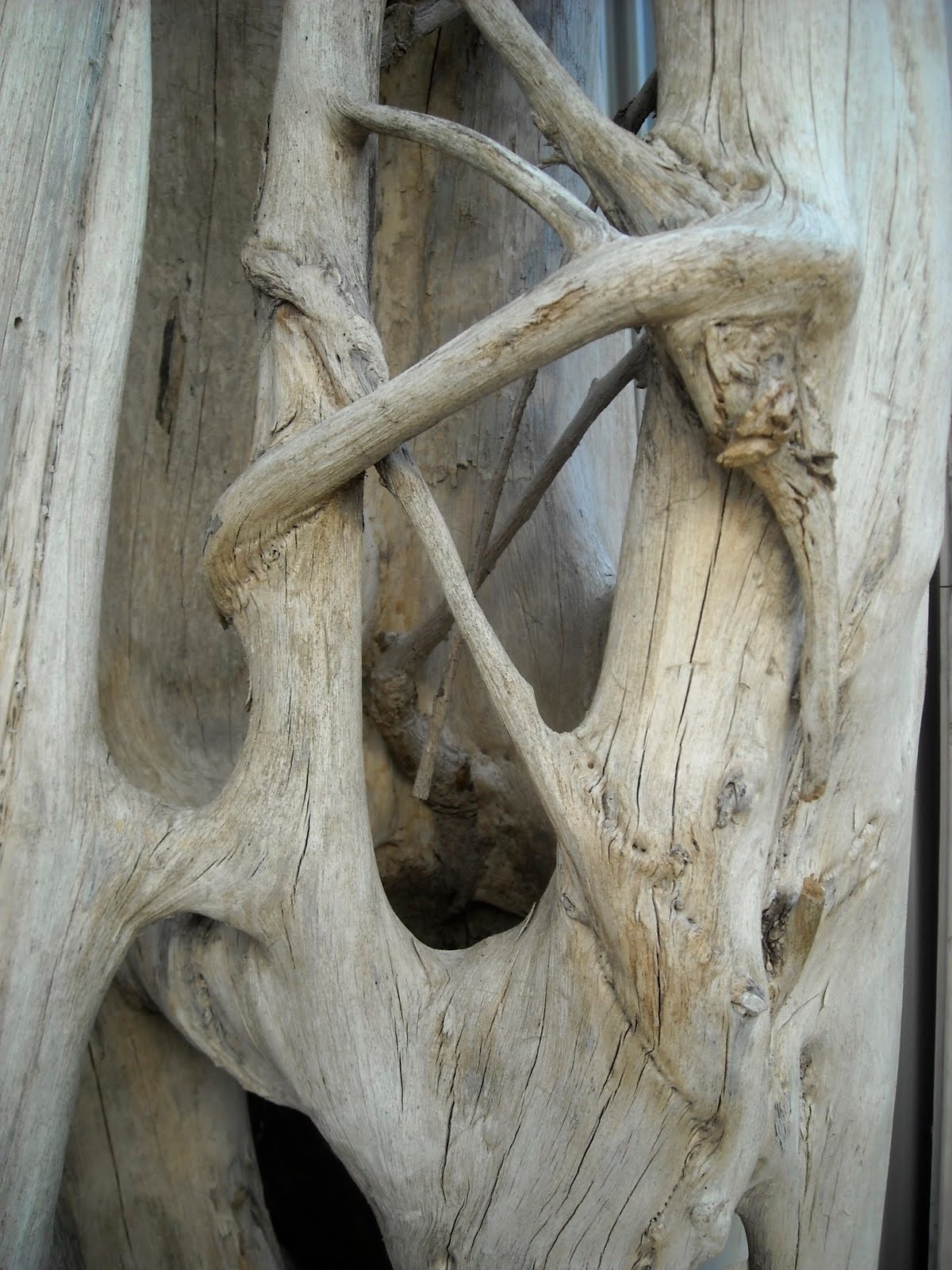
This is actually a close-up photograph of a special strangling vine. However, you can find similar unions between two or more roots in a walk along the Pacific CA coast near my house. The naturally grafted roots do not pass any significant nutrients between the trees. But the union helps the trees to be even more sturdy to high winds.

Here’s the description from the store that sells these vines of what they are all about. (Have plenty of money because the cheapest ones start at over $1000.00!)

http://www.artefactdesignsalvage.com/products-page?id=19&car_num=1&start=1

A completely natural strangler vine form shaped by years of growth around a host tree. Its current appearance is achieved by carefully cutting the tree out of the center so only the vine remains. Next the vine’s own bark is removed, and then every inch is painstakingly sanded by hand. This is one of our larger, more striking forms. Great as a natural work of art indoors, or a beautiful garden sculpture outdoors. Will fade to a driftwood grey if exposed to the elements.

“BUY FROM THE SOURCE TO HELP KEEP WRITERS WRITING”


Let me know what you think. Visit my web site to learn about my new book on drip irrigation and other gardening books. Thanks, Robert

Monday, September 14, 2009

Root Bondage


Here’ a view from above of what’s left of an apple tree’s roots growing in a wire basket.

Wire baskets around here are becoming required planting additions for perennials, shrubs, and trees. I once had a wire basket protecting the apple tree in the photo. The wire was four inches above the mulch. That didn’t stop a gopher from climbing over the wire to be encaged with all those succulent roots. The tree leaned over and simply died.

As the photo shows [I’m the only person I know of that has excavated the roots as they grow when using wire baskets] very few of the roots got out of the basket to explore a bigger volume of soil. For practical purposes, this tree should have been treated like a container plant—keeping all the moisture, fertility, and mulch within the basket’s diameter. BUT, the wire must extend 6-12 inches above the mulch to have a shot at excluding these pesty critters. Such a wire basket is very hard to make and isn’t to be found commercially. Your up to your own to make a Rube Goldberg machine-made, anti-gopher basket .

However, wire baskets can work with smaller plants.


Please post a comment - I want to know what you think.

Visit my web site to learn about my new book on drip irrigation and other gardening books.


NOTE: The comments section at the bottom of the post has disappeared. Click on the "___ Comments" button or the title under the "Blog Archives". Thanks, Robert

Friday, June 26, 2009

Ramblin' Roots


Sadly, few people still realize how a tree's roots actually grow. The color illustration was to advertise a local garden tour in 2009. Notice the roots don't extend beyond the dripline of the foliage. No way. As seen in the illustrations below roots extend far beyond the foliage. (The other 2 B&W illustrations come from my book - Roots Demystified. The one on the left shows the dripline as a dotted line and the roots beyond..)

When I had a landscape maintenance company, I soon discovered that in a good soil, a tree’s roots will often grow to occupy an underground area wider than its dripline. If led by available moisture and nutrition, a tree may tunnel its roots through soil space ranging from an area one-half wider than the dripline to as much as three times further. In special cases, tree roots may ramify much more than anyone would imagine. If you add a subsoil barrier such as rock, bedrock, or caliche (hardpan), a tree’s roots will wander even further beyond the canopy area in search of food. A deep sandy soil offers little resistance to growing roots and allows for root exploration of three or more times the width of the tree. And, like a gardener struggling to dig heavy clay soil, roots don’t like clay either and don’t make much headway through it, perhaps only one-half the width of the dripline.

Some more examples include:

- Poplar (Populus generosa) can ramify 77% of its roots beyond the dripline.

- Another study found that 35% of poplar trees grew roots greater than two times the distance from the trunk to the edge of the foliage.

- Colorado blue spruce (Picea pungens ‘Glauca’) grow 60% of their feeding roots beyond the dripline.

- White green ash (Fraxinus pennsylvanica) grew roots which were 1.68 times the radius of the dripline.

- In one study, the glorious magnolia (Magnolia grandiflora), had grown roots 3.77 times wider than the dripline.

- Sugar maples (Acer saccharum) produced roots that have been found spreading underground 30 feet beyond branch tips.

- The roots of honey locusts (Gleditsia triacanthos) can reach nearly three times beyond the dripline of the foliage.

Please post a comment - I want to know what you think.

Visit my web site to learn about my new book on drip irrigation and other gardening books.


NOTE: The comments section at the bottom of the post has disappeared. Click on the "___ Comments" button or the title under the "Blog Archives". Thanks, Robert

Thursday, March 26, 2009

Don't let roots circle when planting trees & shrubs


Spring is tree-planting time for many gardeners. It's also the time to make big mistakes when planting. Alas, this tree popped out of it's planting hole due to poorly-trained landscape contractors after being struck by a car. This poor tree needed to get its roots away from the planting hole. (You can see the circling roots just the way they were in the planting container.) Planting on a mound will help "drive" roots away from the tree's base as it drys out faster, making the roots seek moisture further from the trunk. So will fracturing the sides of the hole. (This tree may have been "planted" by auguring a hole in the ground and just plopping the tree into the hole.) The roots responsible for absorbing water and nutrients are the very young and tiny root hairs found near the tips of new roots. Older roots, much like older branches, have a bark-like covering that protects the root but doesn’t produce root hairs. In one study done with radioactive isotopes in England, the roots 4.5 feet away from the trunk of a 10-year-old apple tree absorbed less than 10% of the water and nutrients absorbed by the entire root system. The study showed that proportionately, many more feeding roots are found at, or beyond, the drip line of a tree’s foliage. Because of this, I prefer to place a ring of in-line emitter tubing at or beyond the tree’s drip line. This produces a “doughnut” of moisture, and far more of the root zone is adequately irrigated than with a single line of hose down a row of trees. As the tree grows, extra lengths are added to this circle of moisture to correspond with the new growth in the canopy. By setting the circle of emitters farther out every few years, you’re encouraging the tree’s roots to explore more soil volume and gather more nutrients for superior growth. Such trees would stand a better chance against wayward cars.

Note: I somehow lost the usual section "Post a comment". To leave a comment, simply click on the area/button that says "___ Comments" below. Or, clicking on the title of a Post under "Blog Archive" also gets you to a view that gives the option of leaving a comment. Robert

Visit Robert Kourik's web site to learn about his great gardening books.

Saturday, May 31, 2008

Mulch 'Mators


The perfect tomato is the Holy Grail of many gardeners. Especially in the coastal, marine-influenced climate where I live. I’ve watched neighbors plant tomatoes where the summer fogs are frequent and nurture, worry, persist and try every way they read in the books and magazine articles to eke out a handful of tomatoes. Probably at a real cost of $10 per tomato, or more. Whereas just 2 miles east, over the high hump of the land that captures so much summer fog, tomatoes thrive. So, I buy them at the farmer’s markets and save lots of money and elbow grease.

Back in the ‘30s a man named John Weaver had the patience to excavate entire root systems. He dug a trench along side of the base of each plant and proceeded to excavate, scrape, and dust his way through soil – much like an archeologist at work - to reveal in exquisite detail the full extent of a plants root system. He (or someone else – the book makes no comment as to who did the drawings that resemble etchings) mapped mostly economic vegetable crops. Weaver must have been the Saint of Patience. I often wondered if he had a wife (no search found any clue) who could understand his work and have the same patience he must have had.

In Weaver’s experience, a tomato seed planted in ideal outdoor soil, with no transplanting involved, can grow a taproot to the depth of 22 inches at a rate of one inch per day. The tomato is yet another vegetable that prefers to grow a taproot, which is often damaged during transplanting. Young seedlings transplanted several times into increasingly large pots before their final move into the garden will probably end up with a root system more fibrous than that of tomato plants planted by seed in the garden which are allowed to grow a conventional taproot. However, transplanting tomato-plant stems deep into the soil will produce many adventitious roots along the length of its stem (See Weaver’s illustration.), creating a great root system early in the life of the plant, more advantageous than seed grown in the garden.

The illustration is drawn on a one-square foot grid (Taken from my book Roots Demystified, change your gardening habits to help roots thrive.) and shows how massive the root system is for one plant. At seven feet wide it changes one’s perspective of how much mulch is required to keep all the roots happy. In cool climates you might experiment with paper from an office or home shedder to help reflect light into the canopy of the plant. Turn all those shredded unsolicited checks from your credit company into wonderful tomatoes!

I don’t know of anyone planting tomatoes by direct seeding in the ground. Do you?

Please post a comment - I want to know what you think.

Visit my web site to learn about my gardening books.


NOTE: The comments section at the bottom of the post has disappeared. Click on the "___ Comments" button or the title under the "Blog Archives". Thanks, Robert
Thursday, May 29, 2008

Roots Grow Up!


Surprisingly, many of a tree’s feeding (not “structural” roots) roots grow up, not down. In a paper published in The Landscape Below Ground (International Society of Arboriculture, 1994. pg. 3), Professor Thomas O. Perry states “Most tree roots range in diameter [from that of] of a lead pencil to the size of a hair. These smaller roots…grow upward into the surface inches of soil and the litter layer.”

The significance of the importance of the most aerobic layers of the soil and duff can be seen in a simple study using potted tree seedlings. You can see the dramatic difference in the illustration of growth between the three soil depths. The seedlings in the pot on the left are growing in soil collected from the top two inches. The middle pot has soil only from the 2-4 inch depth of a forest floor. The pot on the right is trying to grow in subsoil.

The top two inches is so vital to a tree’s health, whether it’s native or ornamental. This is also the favorite two inches for all the plants in a humid climate with periodic rains. Take away that top two inches by planting it to lawn, raking the duff up for “a cleaner look” or allowing so much foot traffic that the roots are exposed, and you have a disaster in the making. This is perhaps the most important illustration in Roots Demystified because it so graphically reveals where tree and shrub roots prefer to grow and feed.

The photo is of a cross-section of three feet of soil beneath a vineyard. Most of the roots are in the top foot or so of the soil. Below that level it gets increasingly more like clay subsoil. (If you click on the image to enlarge it, you will see a few roots below the first foot and even a few that found the lens of gravel.)

The aerobic-loving soil life – where you find the most soluble nutrients - needs to breathe. The deeper you go, the less aerobic you get, and the number of “good guys” (beneficial soil flora) will rapidly diminish. Studies done with agricultural plants provide a lot of useful information. One example is alfalfa, it can grow roots much deeper than peach trees can, yet both get most of their moisture (along with nutrients) in the top one to two feet of the soil.

But trees still need “dirt”. Perry puts it quite succinctly when he says that trees on soils as little as five inches thick produce only poor tree and shrub growth. (one can then imagine how far the roots must grow laterally in the shallow soils to gather sufficient moisture and nutrients.) You can get fair growth with a ten-inch depth, good growth at 16 inches and excellent growth with 20-30 inches of topsoil. Most remarkably, according to Perry, the tree vigor is likely to gradually decrease with soil deeper than 30 inches. (The Landscape Below Ground, International Society of Arboriculture, 1994. pg. 9)

A PRACTICAL TIP FOR GARDENERS
As I’ve often said: mulch, mulch, mulch. Replicate the duff that forms in a natural forest. Establish as many permanent pathways as possible. Try to let the pathways “breathe”—allowing the air to flow into the roots and the carbon monoxide to be expelled. You can use chipped bark, chipped tree trimmings, gravel or whatever local material suits you.


Please post a comment - I want to know what you think.

Visit my web site to learn about my gardening books.


NOTE: The comments section at the bottom of the post has disappeared. Click on the "___ Comments" button or the title under the "Blog Archives". Thanks, Robert

Tuesday, March 18, 2008

Shameless Self Promotion


Roots ain't sexy. But plants need them to be healthy.

Thus I wrote a book about how roots really grow and ways a gardeners can have a better garden via healthy roots - Roots Demystified, Change Your Gardening Habits to Help Roots Thrive.

Check out my web site for more information (sample pages) and how to order: www.robertkourik.com

The book has been listed in Publisher's Weekly. They receive 1500 books per month and only list 450.

The best news came from the Midwest Book Review (one of the top 4 book reviewers for librarians):
“Superbly written and thoroughly 'user friendly', ‘Roots Demystified’ is profusely enhanced with twenty-five illustrative graphics showcasing extraordinary illustrations of excavated root systems in their entirety. A compendium of practical, comprehensive, and exceptionally well organized information, advice, tips, and observations that will benefit novice gardeners and seasoned professionals alike, ‘Roots Demystified’ is an excellent and strongly recommended addition to personal, professional, academic, and community library Gardening/Agriculture/Horticulture reference collections and supplemental reading lists.”

Here's my speaking schedule for now. 

March 30th. - On the radio on Michelle Anna Jordan's show "Mouthful" along with the extraordinary gardener Kate Frey of Fetzer Garden fame (who has also won prizes at the Chelsea Garden Flower Show in the UK.) 7-8PM on KRCB 91.1, in Santa Rosa CA 90.9 both on the FM dial.

April 5th - Book signing at Copperfield's Books in downtown Sebastopol. 11AM to noon.

April 15th (after paying your taxes - it's free!) - Oakmont, the Berger Center. 10-11AM (email me for directions - rkourik@sonic.net)

May 3rd - Lecture at Harmony Farm & Garden Supply, Graton, CA 10-noon.

May 18th - Book signing at Sonoma Mission Gardens 1851 Craig Ave., Sonoma, CA 4-6PM. 

I hope to meet you at one of these events.