Showing posts with label tree roots. Show all posts

Monday, April 26, 2010

Root Bondage


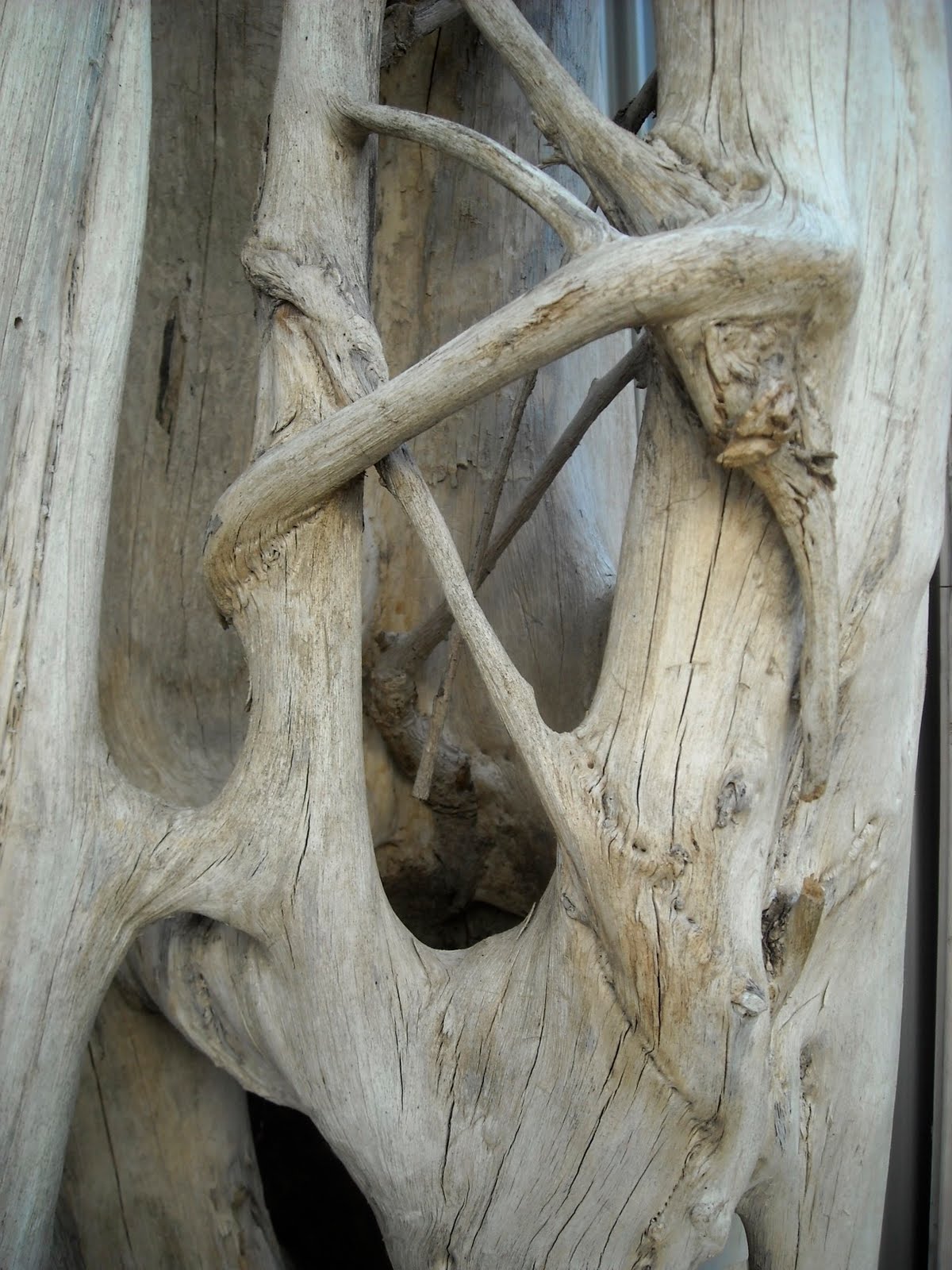
This is actually a close-up photograph of a special strangling vine. However, you can find similar unions between two or more roots in a walk along the Pacific CA coast near my house. The naturally grafted roots do not pass any significant nutrients between the trees. But the union helps the trees to be even more sturdy to high winds.

Here’s the description from the store that sells these vines of what they are all about. (Have plenty of money because the cheapest ones start at over $1000.00!)

http://www.artefactdesignsalvage.com/products-page?id=19&car_num=1&start=1

A completely natural strangler vine form shaped by years of growth around a host tree. Its current appearance is achieved by carefully cutting the tree out of the center so only the vine remains. Next the vine’s own bark is removed, and then every inch is painstakingly sanded by hand. This is one of our larger, more striking forms. Great as a natural work of art indoors, or a beautiful garden sculpture outdoors. Will fade to a driftwood grey if exposed to the elements.

“BUY FROM THE SOURCE TO HELP KEEP WRITERS WRITING”


Let me know what you think. Visit my web site to learn about my new book on drip irrigation and other gardening books. Thanks, Robert

Sunday, June 15, 2008

Pop goes the weasel (tree)


As written in my book Roots Demystified, Change Your Gardening Habits to Help Roots Thrive, amendments are materials such as sand, peat moss, compost, and rice hulls have been added to the planting holes to supposedly improve drainage and keep the soil loose and friable. Fertilizers, such as blood meal, cottonseed meal, greensand, and wood ashes, are those ingredients added to provide mostly nutrients. Some amendments, such as compost, are thought to do both improve drainage and act as mild fertilizers.

One of the best studies of the effect of amendments for fertility was done at Oklahoma State University at Stillwater by Joseph Schulte and Carl Whitcomb. They planted 108 silver maple trees with 11 different soil treatments and a control (untreated planting hole). One conclusion was: "no benefit was derived from the use of soil amendments either with a good clay loam soil or a very poor silt loam subsoil." They found that the control plantings with no additional amendments generally outperformed the plantings with amendments for drainage and fertility.

The loose soil of the amendments in a traditional planting hole makes something like an underground swimming pool full of water when it rains hard, drowning important root hairs. Adding a lot of amendments only leaves the roots unprepared for the shock of what lies beyond the amended area. (And nobody can amend the area of the mature root system seeing as how much wider it is than the foliage.) Often the roots fail to make it out of the well-amended hole and merely circle around in the loose planting medium, rendering the trees likely to blow over during a storm. The trees most tolerant to wind are those with the widest root systems. Or, as the photo shows, not spreading the roots when planting can allow the tree to simply pop out of the ground when hit by a car or pulled out by hand.

Please post a comment - I want to know what you think.

Visit my web site to learn about my gardening books.


NOTE: The comments section at the bottom of the post has disappeared. Click on the "___ Comments" button or the title under the "Blog Archives". Thanks, Robert